
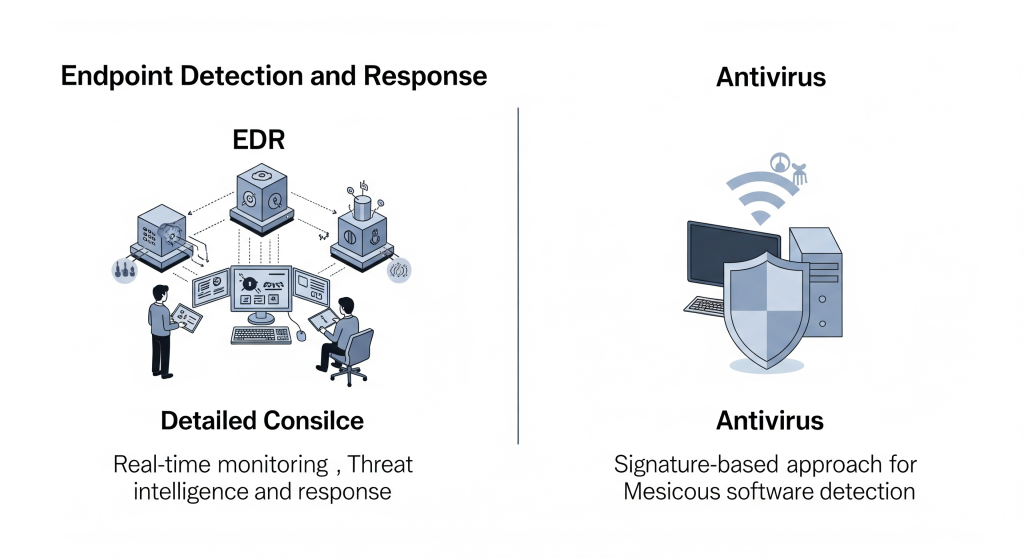
I have been pitching EDR solutions for as long as I have can remember now. Just yesterday during a casual conversation with a friend it dawned on me “Started with purpose, got stuck in process.” when he asked me why is my good old anti virus not enough for securing our endpoints. I probably got what I like to call – “I knew everything… except where to begin”. While there is no finite list of comparison Hence I thought this was a good time to give a structure to the comparison.
Cloud-Native Architecture
CrowdStrike Falcon, for example, is built from the ground up as a cloud-native platform. This means:
- Lightweight agents with minimal system impact
- Real-time threat intelligence and telemetry
- Seamless scalability across thousands of endpoints
Advanced Threat Detection & Response
CrowdStrike and Coro.net offer:
- “EDR/XDR capabilities” (Endpoint/Extended Detection and Response)
- AI-driven behavioral analytics
- Automated incident response
These features go beyond signature-based detection, which is still a core method for our old and trusted Anti Virus Solutions.
Ease of Use and Automation
Coro.net is praised for its “user-friendly interface”, “automated remediation”, and “strong support” — making it ideal for lean IT teams or MSSPs like yours. CrowdStrike, while more complex, offers deep customization and integration for mature security operations.
Enterprise-Grade Features
- “Coro.net” includes built-in “email security”, “DLP”, “ZTNA”, and “cloud firewall” in one platform—streamlining security operations.
- “CrowdStrike” excels in “threat hunting”, “vulnerability management”, and “zero trust enforcement”.
Lastly, Most or all of our most popular traditional anti virus solutions are more consumer-focused, with features like parental controls and VPNs, which are less relevant in enterprise-grade security stacks.